

Chapter One
With consummate ease born of years at the helm, Captain Jack Trevelyan brought his new lugger, The Fly, a boat he’d only taken possession of a month ago, past the dangerous Enys rock and into the shelter of Bessie’s Cove. She handled like a dream, and not just thanks to the experience of his crew. Their combined skills helped, of course, but the fact that they were working with a sleek greyhound built for speed and easy handling played the biggest part. Jack had found, to his delight, that The Fly responded almost to his very thought, like some living sea creature given into his hands. He patted her gunwales with a proprietorial hand, as though she were a woman, grinning as she skimmed through the shallower water towards the beach.
As they lost the wind between the cliffs, The Fly slowed, and her crew took down her now sagging sails. They worked together like the well-greased cogs of a clock, and he had no need to issue any orders. Within minutes, they were as far in as their draft would allow, with an anchor down stem and stern to steady them, as the bo’sun, Jack’s boyhood friend, Daniel Bussow, organised the launching of the gig.
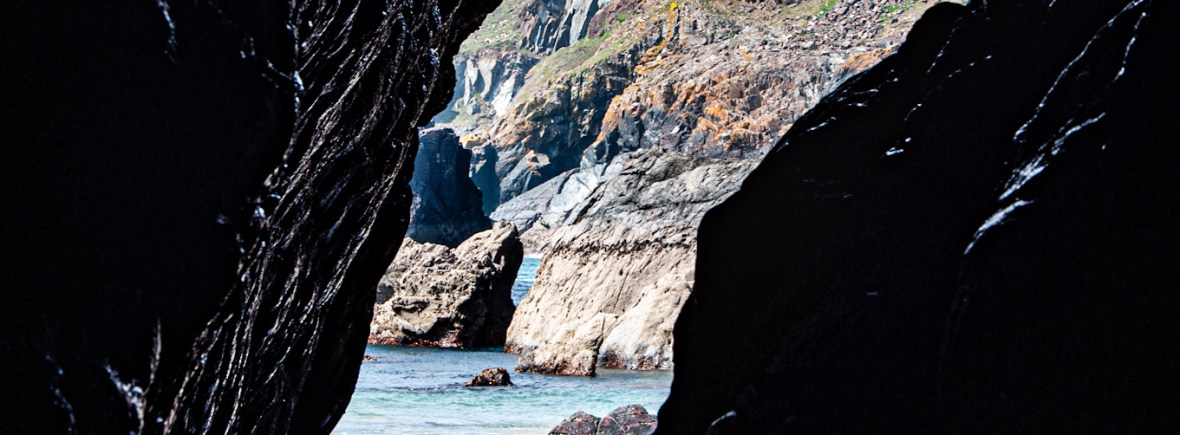
Jack raised a hand to shade his eyes as he peered inland. The cliffs here weren’t particularly high, but the way they overhung the narrow inlet provided as good a hiding place as any for a non-too-large boat. To see down into the cove from the cliff path, any nosy person had to get right to the edge. And the same went for out to sea. Once in the sheltered waters of Bessie’s Cove with their sails furled, no passing revenue cutter would be able to spot them.
No wonder John Carter, Daniel’s uncle and the self-styled King of Prussia, had set up business here back in the last century. He was long dead now, but Jack partnered with the man who’d carried on his tradition, his son-in-law, Captain Will Richards. Thanks to the two of them, the well-earned reputation of the Carters lived on.
Was that Will on the eastern cliffs now, watching them unloading the goods? Most likely. Jack raised an arm and gave the distant figure a leisurely wave. He received a wave in return.
The crew, scarcely needing any organizing from Daniel, unloaded the ankers of gin, brandy and rum they’d picked up in Roscoff into the waiting gig, as she bobbed beside the larger boat, along with a couple of chests of tea and several bails of silk, one of which Jack had earmarked for his own mother’s use. Down on the little sandy beach, Will’s men were already shoving their own gig into the waves to come out to help.
“Thassa good run,” a gravely voice to Jack’s right said.
He glanced at the old man by his side. Old Tummels, gripping the ratlines in one hand, rubbed his whiskery chin, as averse to doing any lifting work as always, but forgiven it thanks to his appearance of advanced old age. He paid Jack’s father a peppercorn rent for a tumbledown cottage on the westerly headland that Jack had more than once offered to improve. He’d been turned down every time. For some reason, Tummels seemed to enjoy both his isolation and the conditions he lived in, and, as he only worked when he needed a few shillings for his ale, he wasn’t often a member of Jack’s crew.
Jack had known the old man all his life. “So it should be,” he said, glancing left towards the westering sun. “Be dark soon.”
“Cap’n Will – be he a-goin’ to store the kegs in the caves ternight? Or mebbe down one o’ they shafts?” The old man might well be thinking of tapping off a bottle or two for himself, unobserved. He’d been known to do that before.
Jack shrugged. He’d done his bit by bringing this consignment over from Brittany. It was up to Will to sort out where it went, and how safely stored it was. Jack didn’t much care about who got what profit out of it, so long as he made his bit. After all, with what his father had put in trust for him, he didn’t really need the money. But he did need the excitement. He wasn’t about to stop making these trips back and forth across the channel in a hurry.
With the gig well filled, Phoby Geen, another of Jack’s boyhood friends, who’d been steadying her by holding one of the ropes hanging from the side of The Fly, settled himself at the oars. Young Harry Richards, Will’s son and heir who’d accompanied them on this trip to Roscoff, took the other. The two young men put their backs into it and pulled for the shore.
They passed the other gig on its way over and soon that was being filled with the remainder of the cargo.
Jack swung down from where he’d been standing in the bows, grabbed the last anker of brandy and passed it down. With a grin, he hopped over the gunwales and slid down a rope to land lightly in the gig. “I’ll take an oar.” This gig was larger than the one they carried on The Fly and would take four men to row it.
Hosking, their carpenter, shifted over on his thwart and Jack settled beside him, taking hold of the butt end of one of the oars. As he did so, he happened to glance to his right again, westwards. Movement caught his eye. A skirt billowed. Was that someone else up on the edge of the cliffs, out near the tip of the headland, staring down at them? A girl by the look of it, her gown catching in the stiff sea breeze and her long dark hair blowing out behind her. Where the hell had she come from? The only houses hereabouts were Will’s own, out above neighboring Prussia Cove at Porth en Alls, Bessies Kiddleywink, near where he’d spied Will waiting, Tummel’s single story fisherman’s hut on the western headland, and that empty thatched cottage some far-off widow-woman owned, standing just back from the cliffs. No one had lived in it since Brewinney Pascoe’d gone over the cliffs onto the rocks below.
So where had a strange girl appeared from?
 Fil Reid - Author