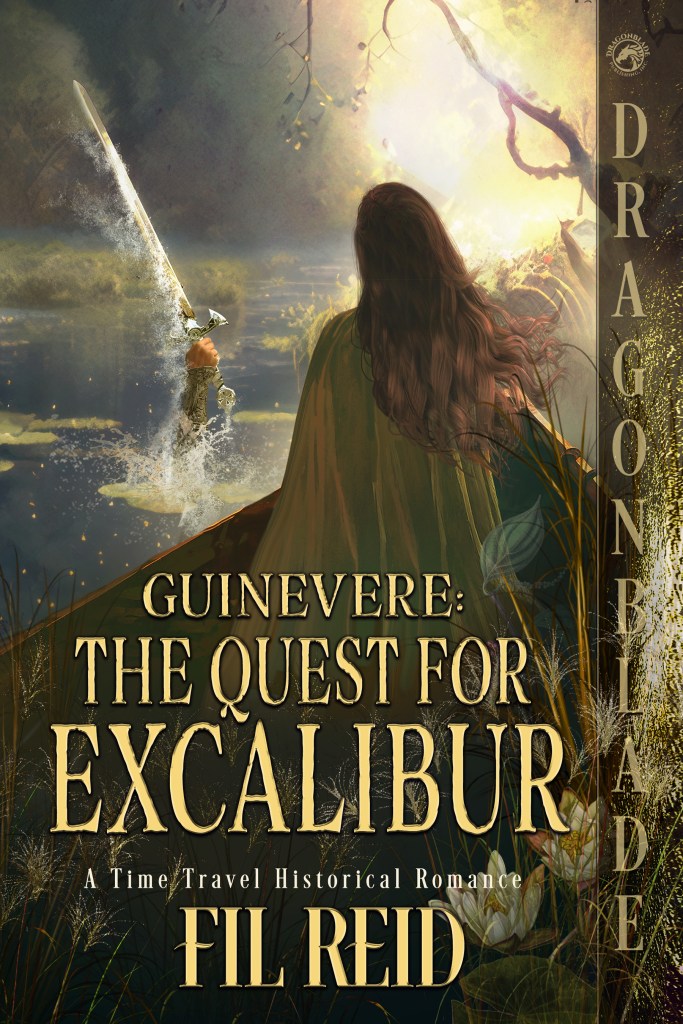
Book Five – Guinevere: The Quest for Excalibur

Chapter One

Outside the hall, a fierce, wintry wind buffeted the vast thatched roof, but inside we were snug. Maia, my maid, had long since latched the wooden shutters on the few windows and hung heavy rugs over them to keep out any sneaking drafts. On the square of bare flagstones in the center of the chamber, a brazier of red-hot embers glowed, and on the walls, smoky torches in their iron brackets spread flickering semi-circles of light.

            Seated at the table, with half-a-dozen candles illuminating my work and my stockinged feet buried for warmth in the thick wolf pelt that covered the flagstones, I chewed the wooden end of my pen, an object already misshapen from the attentions of my teeth. For comfort, two layers of sheepskin on my chair cushioned my bottom, and around my shoulders hung my fur-lined cloak. It being winter, my usual occupation held me in its thrall. Writing, especially in the Dark Ages, could be a chilly business.

            Open on the table before me lay the book I’d commissioned from the only source capable of fulfilling such a specific order. Monks. Our nearest brothers kept the monastery at Ynys Witrin and had been taken aback by my request. Or rather, by my husband’s order. As far as they were concerned, writing in books was their work, not that of a woman, no matter that the woman in question happened to be a queen. Their queen.

            I’d insisted, and so had my husband, Arthur. As their king – the High King of all Britain – had ordered it, they’d been forced to comply, albeit grudgingly. Now, here it lay in front of me at last, a mixture of the impatient pages I’d already written, that had been pried from my unwilling fingers, bound with great care, and no doubt read with salacious curiosity, and new empty ones, ready for me to fill.

            My demand for blank pages had also offended them.

            “Pages are written first,” Abbot Jerome had declared, on his high horse and looking down his long nose at Arthur. “Only then are they sewn together and bound. No one ever has empty books.”

            Or they hadn’t until I’d asked for one.

            “And women do not bother themselves with reading and writing.”

            This last statement I knew to be untrue, as Arthur’s sister, that devious witch Morgana, could certainly do both, although the abbot, a man of old-fashioned ways, didn’t know that. He’d had to stifle his protests and have the book made. It had been delivered this morning, after a number of probably artificially induced delays.

            My hand touched the leather-bound cover, the darkly stained calf-skin smooth under my possessive fingers, caressing it as lovingly as I would have done a first edition of a rare book back in my old world – the twenty-first century. A lot of time and skill went into book manufacture, and the leather had been carefully worked and treated to last.

            And last was something this book would have to do – last forever. It would be a thorough record of the history of the Dark Ages, a time when barely anything was written down.

            Where I came from, only the work of one man from that era had survived, and who knew if he’d truly been the only one to commit pen to parchment? Others, monks all of them, might well have written books that had been lost to the ravages of time, books that might have told a different story.

            The famous author of that single surviving tome went by the name of Gildas; a man who happened to be my friend. Right now, he was still a young monk living at Ynys Witrin, learning his trade, the trade of words, under the tutelage of Abbot Jerome.

            If my luck held, this book I was writing would survive, and Arthurian scholars would have the proof they needed that my husband, the legendary King Arthur, had truly existed. The Book of Guinevere. My book.

            It was large and heavy, a good two feet tall by over a foot wide, and on the front some kind monk – I liked to think it could have been young Gildas himself – had embossed a dragon curled like a sleeping cat about the foot of an ornate Celtic cross. He would have known I’d like the imagery.

            With trembling fingers, I lifted the hefty, leather-covered board that stiffened the cover and examined the first page. Someone, perhaps the same person who’d embossed the cover so imaginatively, had taken great care over the painting in the center. Under an apple tree heavy with rosy fruit stood a woman. Behind her loomed the distinctive hump of the Tor – Glastonbury Tor, the doorway by which I’d made my entry into this world. Not that Gildas would know the significance.

            The woman wore a long blue gown, her hands eloquently held out to either side, like some proto ballerina striking a pose. The artist meant her to be me, but she bore almost no resemblance. I smiled at the image – so textbook medieval in appearance, such a stereotypical queen with a long face and a small crown on her head. No danger that anyone looking at this in fifteen hundred years would think to say –  “Hang on, isn’t that Gwen Fry, the young woman who was all over the news when she went missing on Glastonbury Tor?”

            I turned the page. Here lay the history I’d been writing on and off for the last seven years, ever since the determination to set the facts straight had come upon me. Lines of small, neat writing, that I’d had to spend time perfecting before I dared set pen to vellum, marched across the pages. No pencils and erasers here – if I made a mistake, which I often did to start with, I had to carefully scrape away the ink with a razor-sharp knife, damaging the perfect surface of the vellum.

            “The Departure of the Romans” read the first title. I’d spent much more time on research than I’d spent on writing, gathering together all the facts I could squeeze out of people, especially the oldest inhabitants of Din Cadan.

            As the Romans had left getting on for a hundred years ago – or so I reckoned, there being no one to tell me what exact year this might be – no one remained alive who’d met them. So little had been written down that my task had proved almost impossible. Ask ten people what they know of something that happened that long ago and you get ten different versions.

            Picking through them to make a proper history had turned into a nightmare of contradictions. I rapidly discovered, for instance, that nobody had any idea the Wall that separated southern Britain from Alt Clut, Guotodin and beyond them the Picts, had been built at the start of the second century by order of the Emperor Hadrian. Those few who knew it existed thought it a much later construction, and one or two people had told me in all seriousness that giants had built it.

How not to hold a book launch

Or in other words, how whatever can go wrong inevitably does go wrong.

My first two books in the Guinevere series, The Dragon Ring and The Bear’s Heart, came out in winter, so the weather was bad, and covid was still about and if I’d done an in-person book launch back then we couldn’t have had the doors and windows open. So, when I found out my third book, The Sword, was coming out on May 31st, I rashly decided I could do a proper launch. Haha – silly me.

Firstly, when I set the date for the 3rd of July, I completely forgot that would be in the middle of Wimbledon fortnight until someone mentioned it to me on July 1st. Mistake number one. Too late by then to change anything, this only added to my rising stress. The cause of all this stress was the non-appearance of the extra copies of books two and three, The Bear’s Heart and The Sword, my agent had ordered for the book launch. From being terrified no one would come and I’d be speaking to an empty room, my fears swung sharply in the other direction, and I decided I didn’t want everyone to come because there wouldn’t be enough books.

Panic stations. I ordered some full price ones from amazon using my son’s Prime account. Mistake number two. Firstly, they were more expensive than I was planning to sell them for, and secondly, we chose to have the order delivered to a shop with an amazon hub that was open (according to amazon) until 11pm at night. With a message on amazon saying they’d be delivered by 10pm on Saturday the 2nd, I spotted that the shop was going to close at 8pm. Luckily for my sanity, they turned up in the nick of time.

However, this wasn’t the only source of stress for the weekend. I’d invited a lot of people, and now they began crying off for various reasons. Seemed like a lot of them had developed covid, which filled me with trepidation that the ones who were coming would possibly have it but not know they did. As I’m writing this a full ten days after the launch and so far, I’m unscathed, I’m thinking they were all healthy.

However, once the initial socialising, and hugging, was over, and we got down to the actual book launch, everything slid into place. I thanked everyone for coming (speaking off the cuff is a thing I don’t like, so I probably missed out things I should have said and gabbled stuff I shouldn’t have) and read an excerpt from the start of Guinevere: The Sword. My friend Diane did a short interview which set me further at my ease. I think I enjoyed that bit the most.

Then, after book signings, it was all over, and we were packing up our things. Jake, my student son, aka The Wookie thanks to his hair and beard, managed to consume any food that was left once we were home. I’m not sure all the stress from beforehand inclines me to do one of these ever again, but you never know, I’ll probably forget that bit and remember the good bits. A bit like how we always remember childhood holidays as sunny.

But don’t forget the third book in the Guinevere series is now out – The Sword, with Gwen well on the road to becoming a warrior queen and journeying north to Hadrian’s Wall to help Arthur. Follow the links on my website for how to buy it.

Welcome to Gareth Williams, retired history teacher and author of Needing Napoleon and Serving Shaka, who dropped in to answer some questions about his books.

FR. What sparked your interest in Napoleon? Is it something you’ve had for a long time? And do you have a Napoleon costume?

GW. I think it started at school. The idea of a Corsican outsider rising through the ranks thanks to the French Revolution to become Emperor of the French captured my imagination. Faced by endless coalitions against him, usually funded by the British, he won battle after battle. I found that pretty impressive! But hubris got the better of him. Spain and then Russia saw him squander the troops that had made him the dominant military force on the continent. Defeat. Exile. It should have been all over, but no! He escapes Elba for France, gathers support and everything culminates in the epic battle of Waterloo – I guess the 1970 Dino de Laurentis film starring Rod Steiger deserves a mention here.    

I don’t have a Napoleon costume but I do have a bronze bust sitting on my desk!

FR. What made you decide to transport someone from the present back in time to witness Waterloo and its aftermath rather than choose as your MC one of the many officers around Napoleon, or even Napoleon himself?

GW. I was interested in the idea that Napoleon could have won the battle of Waterloo. His performance was lacklustre. What if he had better intelligence on the enemy? It was also a way of giving myself the opportunity to tread the battlefield and meet Bonaparte, in the guise of a history teacher, albeit a miserable one!

I didn’t want to write another fictional biography of Napoleon because Max Gallo’s Napoleon series has done that brilliantly. If I had used one of his officers, there wouldn’t be the tension between what they and Napoleon knew.  

FR. What advantages do you think viewing these historical events through the eyes of a modern observer gives the narrative?

GW. I hope it allowed me to explore Napoleon’s decisions on the day of the battle and its aftermath in a fresh way. My MC gives up everything to change the past, but at Waterloo, he finds himself unable to exert the necessary influence. That puts him in a pretty tough spot given there’s no way back to the 21st century.

FR. Have you visited the places you write about, and which was your favourite? And of the ones you haven’t visited, which is top of your bucket list?

GW. I have a pretty good working knowledge of schools! And Paris. But I have never been to the site of Waterloo or Malmaison or St Helena. I lived in South Africa as a boy but Benoni was a modest mining town, a far cry from Shaka Zulu’s capital!

I do love Paris. I would love to visit St Helena.

In truth, I travel in my imagination with the help of books and the internet, which is all most of us have been able to do recently.

FR. What was the most difficult thing to write about, and why was it so? And what was the easiest thing?

GW. I think the hardest things to write about are the most familiar. Everyone has an opinion. There are many experts likely to pick up on the slightest error. So the battle of Waterloo is a good example. It is much easier to write about Shaka Zulu, because so much less is known, it gives room for imagination to fill the gaps, which is fun!

FR. Do you think living on a Scottish island enabled you to empathise with Napoleon’s incarcerations on Elba and St Helena? Do you ever feel incarcerated?

GW. There are two types of people in the world when it comes to islands. Those who see the coastline as a limitation, a barrier, a confinement and those who see endless horizons, security and a clearly defined home. I used to live on Guernsey and loved it. I also love Skye. During the pandemic, the island was quiet and felt reassuring.

I’m not saying I don’t empathise with Napoleon on Elba and St Helena. After all, I voluntarily lived on my islands whereas he was imprisoned on his. I expect we have all wished we were somewhere else at some time, and there is no doubt that is how Napoleon felt.

FR. How many novels are in this series and once Napoleon dies will you go on to further chart your hero’s adventures back in time or will he find a way back to the 21st century?

GW. It is funny you should ask how many novels in the series. My editor wants to know and so does my publisher! The third novel is due out in September. I have committed in my mind to a fourth, although the plot is not fully formed in my head. After that, I’m not sure.

The third and fourth books will be set in the years immediately after those featured in Needing Napoleon and Serving Shaka. According to the rules of my time travel device, a person can only travel back in time on a one-way ticket. So, there is no prospect of my MC returning to the 21st century. He has to figure out a way to live in the nineteenth century, which gives me plenty to write about!

FR. Which authors inspired you as a young man/boy and what are you reading right now?

GW. I loved Tolkien for the sweep and drama of his imagination. I loved adventure stories for boys, most of which probably fail the political correctness test, but I read them with innocent excitement. They were often the same books my father read. Captain W.E. John’s Biggles books, H Rider Haggard, John Buchan, that sort of thing. When I got a bit older, I marvelled at Shakespeare’s plays. They were part of our history and often about history at the same time. I have no pretensions but sometimes feel a kinship with the bard when I plunder works of history for plots and characters. He had Holinshed’s chronicles where I have had Gilbert Martineau, E.A Ritter and J. Leitch Wright Jr.

I am currently reading A Brief History of Roman Britain – Conquest and Civilization by Joan P. Alcock as research for a twin timeline murder mystery I am plotting. I am also reading your book, Guinevere: The Sword, the third instalment of your excellent Arthurian series.

FR. How long have you been writing? And what were your earlier efforts about?

GW. I started trying to write my first novel at primary school. It was an adventure in the future. I finished my first novel at twenty. It was a terrible romance! I kept trying but almost always ended up with convoluted plots and unconvincing characters because I was trying to squeeze writing into a busy life.

My first coherent novel was a product of the first lockdown and the fact that I had recently retired. That book spilled into a second instalment and a third. I then took a pause to write something unrelated. I have just handed that over to my editor. It is the fictionalized biography of a real but largely forgotten man, William Augustus Bowles.

FR.  What advice do you have for would-be writers?

GW. You have to find the time to do it properly. Don’t overreach yourself like I did. If you are busy, write short stories. They can often lead on to novellas and beyond. Plan things in advance. Have a strong outline so that your writing is really like colouring in. Pay attention to characters. Even my minor characters have their own ‘character card’ which I use to record everything I need to know about them. Oh, and one more thing – read!

Of paint pots, grouting pens, errant cats and Merlin

At the moment I’m up to my ears in redecorating our boat. The inside had become decidedly tired looking, and once we started, it didn’t feel as though we could stop. The problem with decorating on a boat though, even though ours is a widebeam, is all your stuff. To get at walls, furniture has to be moved, and with windows taken out we have had to make sure our cat couldn’t escape.

Nancy’s already had one ‘Big Adventure’ this year, although from the way she’s still trying to get out of the boat, she appears to have forgotten how much she didn’t enjoy being a wild and free cat. She escaped one night when Bella (our dog) went out for her last thing at night pee with my husband, and we didn’t find her again for ten long days. Ten days in which we had high winds and storms – this was back in February. She was a very relieved cat indeed when we finally found her hiding in a bush not far from our boat. But now her adventure has faded in her memory, and she thinks a sortie outside is just what she needs. We’re being vigilant, as she’s fifteen and already a bit wobbly on her pins at times. Not a good thing near water.

In between painting various exposed sections of wall in turn and wielding the grouting pen in the bathroom, where I have come to curse the person who put two-inch tiles over ALL the walls, I’ve also been polishing book six of my Guinevere series, The Road to Avalon. I finished writing it a while back and have been slowly giving it a final polish. Slowly because I don’t want to leave it. I’ve been living with the characters of Gwen and Arthur so long now, I don’t want to have to put them away. I was keen to get book six written as I’d been looking forward to it for such a long time, and yet as I drew nearer the end, I knew I was going to be heartbroken to end it all.

I knew from the moment I started writing book one exactly where, and how, book six was going to end, but what I didn’t know was how my characters were going to get there. Banging about inside my head I had all the different legends I knew about the various characters, not all of which I used. It was such fun picking my way around their storylines and in particular popping in various twists and turns to surprise my readers. And killing off a few of my darlings. You’ll have to wait to find out which ones don’t make it to the final curtain call.

I love all the different legends and the endless possibilities they provide for the storyteller. However, if you’ve read my first three books you’ll know by now that there’s one character who will never darken the pages of my books – Lancelot, that French interloper. And nor is there going to be. It does seem, however, that the one story most people know happens to be the one about Lancelot! Ugh! I can’t get the vision of Richard Gere in plate armour out of my head – a total anachronism. Not that I’ve ever seen more than the cover of the video. Not a film I’d want to watch!

In my books, I’ve tried to stick with the characters who have been associated with Arthur from the furthest back in history – such as Cei, Melwas, Medraut, Gwalchmei and Bedwyr. Apart from Merlin, that is. I do know (sadly) that in all likelihood he’s not contemporary with Arthur and was only associated with him at a later date. But kings had advisers, so why not have one called Merlin? This is a work of fiction, after all, and if I want Merlin in it, I can have him. Plus I’ve had a very big soft spot for him since I read Mary Stewart’s Merlin books as a teenager.

Anyway, I thought I’d write a little bit about my Merlin. There have been many renditions of him portraying him as anything from a white-bearded old man (Disney’s The Sword in the Stone etc) to a youth (The Boy who would be King and BBC’s Merlin series). He’s been associated with Arthurian legend for so long, readers/viewers expect to find him in a tale about King Arthur, so who was I to deprive them?

My Merlin is slightly different. He’s young, like Arthur and his warriors at the start of the series, or at least he looks as if he’s young. However, he may well not be. As Gwen remarks to herself – if you had magic why wouldn’t you use it to keep yourself looking young? He’s a warrior in Arthur’s warband, and as far as Gwen knows (at first) his magic consists of him being psychic and able to sometimes see the future, although very annoyingly, not all of the time and especially not when it would be of most use to Arthur and Gwen.

As the books progress, you’ll get to find out more and more about Merlin’s background and he’ll reveal more of the power he possesses. He’s a major character almost on a level with Arthur throughout all six books, and at first, he’s the only one who knows where Gwen has come from. He’s her friend, but in a way he’s also her gaoler, because it was he who kidnapped her back in time for Arthur. Ever wondered what he would have done had Gwen not fallen in love with Arthur? Think he’d have let her go back to her old world? Probably not. He’s an arch manipulator.

If you’re interested to find out more about Merlin’s rather shady involvement in Arthur’s life, and in particular how Arthur came to be born, then go to amazon and order the anthology book ‘Tales of Timeless Romance’. It’s only 99 cents on kindle. The other five stories are by the runners up in the contest I won back in 2021, and I know that at least one of them is about Robin Hood – a story I’m dying to read as it’s by one of my Facebook Friends, Cara Hogarth/Carol Hoggart.

Sunday, 22nd August 2021

South Cadbury Castle – was that Camelot?

I first visited South Cadbury Castle as a child. I must have only been ten or eleven years old, with a head full of images of Camelot as seen in The Sword in the Stone and the musical Camelot, not to mention old Hollywood films, so I expected to see more than just an old earthwork and some muddy trenches. But I didn’t let that put me off. I adapted my view of all things Arthurian and began to realise that it wasn’t about stone built castles and knights in shining armour and page boys pulling swords out of an anvil – yes, an anvil. Why anyone would choose to make the stone the sword was stuck in look like an anvil, which is made of iron, I have no idea.

Since then I’ve been back there many times. You drive into South Cadbury village, past a farm on your left, until you come to a small carpark beside the road. It’s very peaceful. A short walk back in the direction of the village brings you to the lane on the left that will lead you up the hill and in through the lesser northern entrance to the hillfort. Easy to drive past and miss it completely.

The track is stony and uneven, and can also be very muddy. Cows clearly pass along the lane which serves the fields of the local farm. Wellies are a good idea, or at the least, good walking boots. After a bit, you come to a five bar gate with one of those kissing gates beside it – very difficult to get through. It actually can be lifted off its hinges to allow passage, and then popped back onto them afterwards. Far easier than squeezing through the very narrow gap, especially if like me you’re not so slender as you once were.

Nowadays the hillside and the four rows of banks and ditches are shrouded in mature trees. You’d expect to hear birds calling, but it’s very quiet – almost too quiet. The climb up the hill is steep and straight, with high banks to left and right. You can almost feel yourself walking back in time as you climb.

On one particular visit I only got as far as the gate. I was by myself and it was evening, and the trees were even quieter than normal. The atmosphere pressed in on me, and with my hand on the gate I made the decision to turn for home. The restless ghosts of the hillfort didn’t want me there that night.

There’s hardly ever anyone up there. I’ve been many times with my husband, and we’ve often been the only ones on the hilltop. Eighteen acres of grassland rising gently away from the topmost bank, where once a revetted palisade wall stood, with stone foundations and a solid wall-walk around the inside. If you look carefully bits of that stone wall still remain, half-hidden under the turf. Small hawthorn trees dot the perimeter, sculpted by the wind.

The view is magnificent. To the south more hills rise, but it’s the view to the north that fascinates me. The flat plain of the Somerset levels, where once marshland and open stretches of water lay – proven by the fact that it still floods in times of heavy winter rain. And in the far distance, ten miles or so away, the hump of Glastonbury Tor itself, the ruined tower on the summit just visible.

Since I was a child I’ve been convinced this was the orginal of Camelot. Of course, the name’s all wrong. That’s most likely taken from Camulodunum (Colchester on the East Coast) which would have been far too far to the east to have been the centre of any Romano-British warlord’s territory. Most likely it would have been in Saxon hands. Here at Cadbury we’re in the lands of the Dumnonians, a pre-Roman tribe that still existed after the departure of the legions.

Amongst their number was a king named Cadwy, or it might have been Cador, sometimes described as ‘of Cornwall’. Three closely situated hillforts seem to bear his name – this one, Cadbury-Congresbury, and Cadbury Camp near Tickenham. And there’s yet another Cadbury Castle in Devon. Whoever Cadwy/Cador was, he got about a bit.

The magic of this place lends credence to that theory of a sleeping king. When you stand up there, alone, with a wind soughing in the branches of the trees that crowd the slopes, and close your eyes, you could be forgiven for imagining a thriving fortress all around you. Warriors manning the walls, the great hall rising behind you on the summit, a blacksmith working in his forge, smoke rising from thatched roofs, and middens quietly steaming. The ghosts crowd in on you as the wind ruffles your hair and ripples the long grass.

No wonder John Leland, visiting here in 1542, decided the locals were right when they told him it was ‘Camalatte’ and King Arthur had resided there. A myriad of legends are associated with the hill, including one that says Arthur still lies sleeping beneath the surface in a hidden cave. Reminiscent of the Alderley Edge legends. Another says that between Cadbury and Glastonbury Tor runs an old road, the Hunters’ Causeway, and on every Christmas Eve Arthur and his warriors ride the old road. I couldn’t resist using that in my YA stories.

But the story that I like the best is not a legend, but rather a theory. The story behind it goes that after being mortally wounded in his final battle at Camlann, against his upstart nephew, Mordred, Arthur was borne away by three queens to Avalon, where he lies sleeping still, only to return in Britain’s hour of need. Other heroes have similar legends, but what’s most fascinating is the fact that nearly all of them are about real people. Ridiculous as the legends are, those concerned really existed. So, perhaps because Arthur, too, has such a legend, then he, too, was real. And South Cadbury Castle was indeed his ‘Camalatte’.